🔤
Count everyday objects
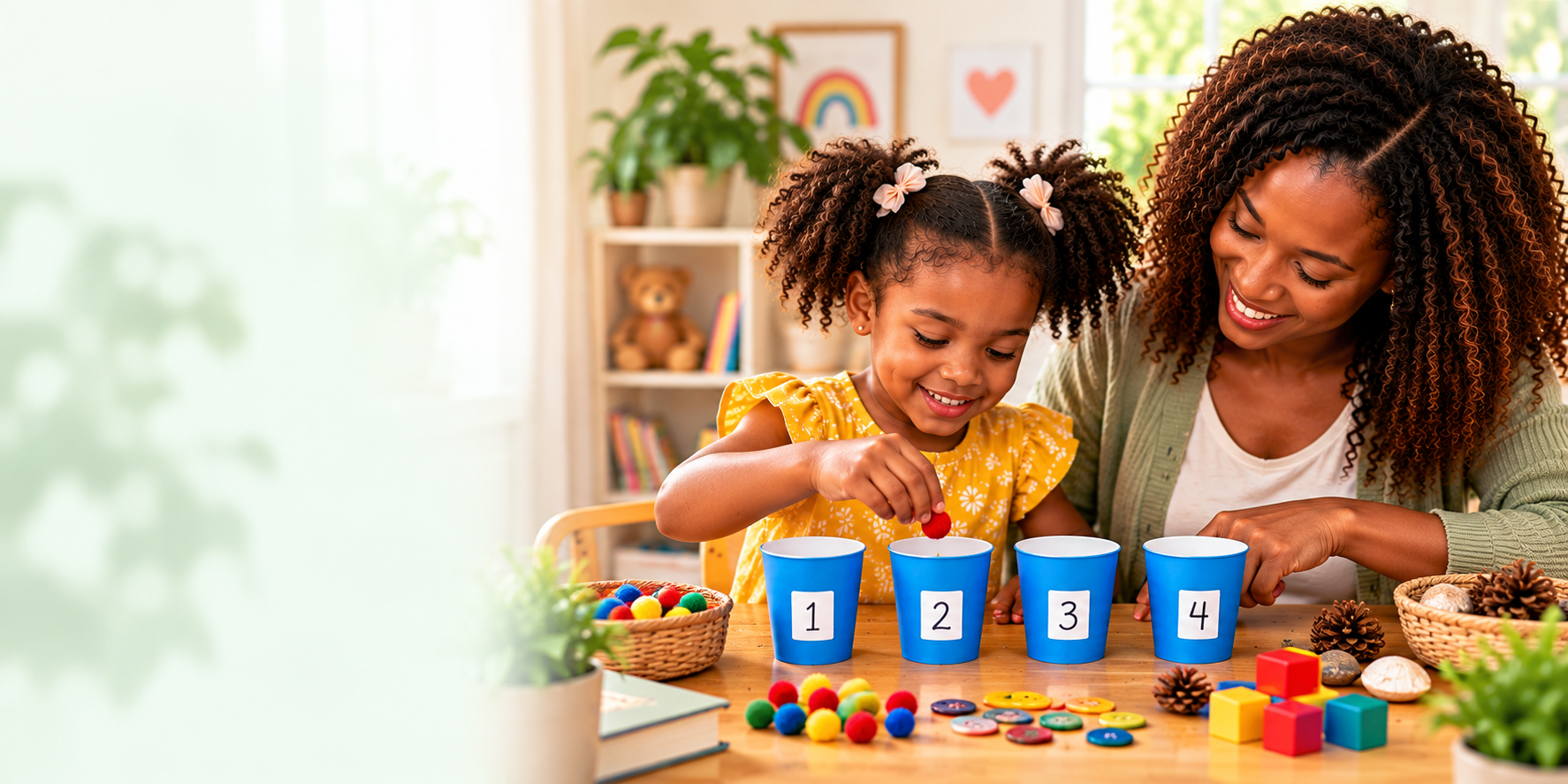
Count toys, spoons, blocks or other everyday objects together and turn counting into a playful activity.
See how to do it ↓Language, movement, counting and exploration with a parent.
Start with short, playful activities that invite your child to talk, move, count and explore with you.
Browse all learning activities →Explore language, counting, movement, sorting, creativity and discovery with simple everyday materials.
Read the guide →Count toys, spoons, blocks or other everyday objects together and turn counting into a playful activity.
See how to do it ↓Sort familiar objects by colour, shape or size and talk together about what makes each group different.
See how to do it ↓Look at pictures together and encourage your child to describe what they see and create a simple story.
See how to do it ↓Use songs, simple instructions and movement games to develop listening, coordination and confidence.
See how to do it ↓Use blocks, cups or safe household objects to build, stack and explore balance through play.
See how to do it ↓Explore leaves, stones and other safe natural items while talking about colours, textures and shapes.
See how to do it ↓Choose an activity to see the materials, steps, questions to ask and ways to adapt the play. Follow your child’s pace; 10 to 15 minutes may be enough.
Learning goal: Build spoken counting, attention and one-to-one matching between number words and objects.
Materials: Five to ten large, safe objects such as blocks, large spoons or toys; two containers.
How to do it: Choose five objects and place them in a row. Touch each one as you count slowly together. Ask your child to give you two objects, then three. Put the objects into two containers and count each group. Finally, combine the groups and count them again.
Questions to ask: How many objects do we have? Can you give me two? Which group has more? How many will we have if we add one more?
Adaptation and safety: Start with three objects and gradually add more. Use large objects without small loose parts, and let your child touch each object while counting.
Learning goal: Notice similarities and differences, group objects and build vocabulary about colours, shapes and sizes.
Materials: Safe household objects in two or three colours or shapes, such as blocks, socks or plastic cups.
How to do it: Place the mixed objects on a table or mat. Choose one feature: colour. Ask your child to group objects of the same colour. Mix them again and sort by shape or size. Finally, invite your child to choose a rule for making the groups.
Questions to ask: Which ones are the same colour? Is this one bigger or smaller? Why did you put these together? Can we sort them another way?
Adaptation and safety: Start with two clearly different colours. Introduce one rule at a time, then let your child invent a sorting rule.
Learning goal: Encourage language, observation, imagination and a simple sequence of events.
Materials: A picture book, family photographs or three simple pictures showing an everyday situation.
How to do it: Choose one picture and look at it together without rushing. Ask your child to say what they can see. Help them make a short story: who is there, where they are and what is happening. If using three pictures, arrange them in order and talk about what happened first and next. Write down one sentence your child says and read it together.
Questions to ask: What can you see? Who is here? What happened first? What do you think will happen next?
Adaptation and safety: Accept single words, gestures and short sentences. Offer choices if your child is unsure, and keep the conversation playful rather than turning it into a test.
Learning goal: Develop gross motor coordination, listening, understanding simple instructions and confidence.
Materials: A clear space free of obstacles; music is optional.
How to do it: Invite your child to play a copying game. Give one instruction at a time: clap hands, raise arms, take two steps, jump in place or walk slowly. Then make movements and ask your child to copy. Finish with a movement song chosen by your child.
Questions to ask: Can you do what I do? What changes when we move slowly? What movement would you like to teach me?
Adaptation and safety: Adapt movements to your child’s abilities. Clear obstacles, avoid jumping from heights and stay with your child throughout the game.
Learning goal: Explore balance, fine motor coordination, problem-solving and ideas about size and position.
Materials: Large blocks, sturdy plastic cups or small lightweight boxes.
How to do it: Show how to place one piece on top of another to build a tower. Invite your child to continue. If the tower falls, observe together and try a wider base or larger pieces at the bottom. Then build a bridge or a line and compare the structures.
Questions to ask: How many pieces can we stack? What makes the tower fall? Which piece should go at the bottom? Can we build a bridge?
Adaptation and safety: Start with three or four large pieces. Value attempts and let your child try solutions. Avoid heavy, fragile or sharp-edged objects.
Learning goal: Awaken curiosity, observe the environment and build sensory and discovery vocabulary.
Materials: A small basket and safe natural items such as fallen leaves, non-toxic flowers or large stones, collected in a safe place.
How to do it: During a supervised walk, invite your child to look at the ground, trees and plants. Collect only safe items that have already fallen. At home, place them on a surface and compare colours, sizes and textures. Return the items to nature when finished, where appropriate.
Questions to ask: What did you find? Is it smooth or rough? What colours can you see? How are these leaves alike?
Adaptation and safety: Stay with your child throughout. Never let them taste plants, seeds or found objects. Avoid unknown plants, fungi, insects and places near traffic or water.